Sardinian Power System
Sardinia is the second-largest island in the Mediterranean Sea and an autonomous region of Italy, located to the west of the Italian mainland and south of Corsica. Known for its distinct cultural identity and ancient history, the island has a population of about 1.6 million residents. Sardinia’s economy is driven by tourism, agriculture, livestock farming, and specialized industries, with growing efforts focused on environmental protection and sustainable regional development.
Sardinian Electricity Grid: status
Sardinia’s high-voltage (HV) and extra-high-voltage (EHV) electrical system consists of approximately 4,357 km of lines at different voltage levels: 380, 220, and 150 kV (limited portions at 70 kV) and 29 electrical substations. The 380 kV EHV network connects the northern and southern parts of the island, where the largest thermoelectric plants are located.
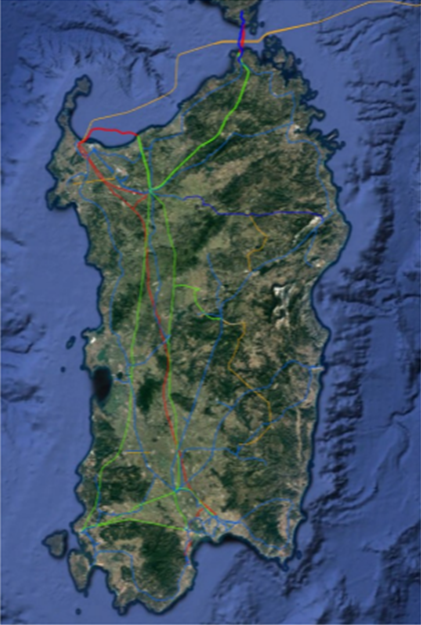
The following is a breakdown by voltage level:
- The 380 kV grid consists of a single 380 kV backbone that interconnects the substations of Selargius, Rumianca, Cagliari Sud, Sarlux, Ittiri, Fiumesanto, and Codrongianos. The longest section of the backbone, the 380 kV Selargius-Ittiri line (approximately 155 km), connects northern Sardinia (Fiumesanto substation) to the southern part of the island, and specifically the industrial area of
- The 220 kV grid includes a ring that connects the industrial hub of Portoscuso/Sulcis to the Codrongianos substation, ending at the Taloro electrical hub.
- The 150 kV grid includes Terna electrical substations and primary cabins (CP) of the DSO. This network, despite the voltage level that usually serves delivery purposes across the national perimeter, also performs transmission functions in the case of Sardinia.
- The 70 kV network includes a small portion of the network in the Nuoro area.
Sardinia is electrically connected to the mainland via two direct current power lines: HVDC SA.PE.I. (Sardinia-Italian Peninsula) and HVDC SA.CO.I.2 (Sardinia-Corsica Italy) undersea cables with a combined nominal transfer capacity of 1,300 MW. An additional alternating current connection, called SAR.CO., connects Sardinia and Corsica. The construction phase of the main Italian electrical infrastructure, the HVDC Tyrrhenian Link — a double undersea connection between Sicily, Sardinia, and the Italian peninsula (Campania) — has already been launched.
Statistical data
According to 2023 data the energy consumption in the island was about 8.1 TWh, losses about 0.5 TWh, pumping consumption 0.2 TWh and the total net production about 11.9 TWh resulting in a net export of about 3.1 TWh.
The renewable production in the 2023 was about 3,9 TWh with 87% from wind and photovoltaic that, considering the energy policies, will continue to grow.
Since 2001 Sardinia is constantly in export. The energy export to the mainland is enabled by the two aforementioned interconnections SA.PE.I and SA.CO.I.2 This capacity is adjusted in real time to ensure safe and reliable system operation. Moreover, these interconnections provide the electrical system with greater flexibility and redundancy, enhancing operational security.
The information related to Statistical data are available on the web:
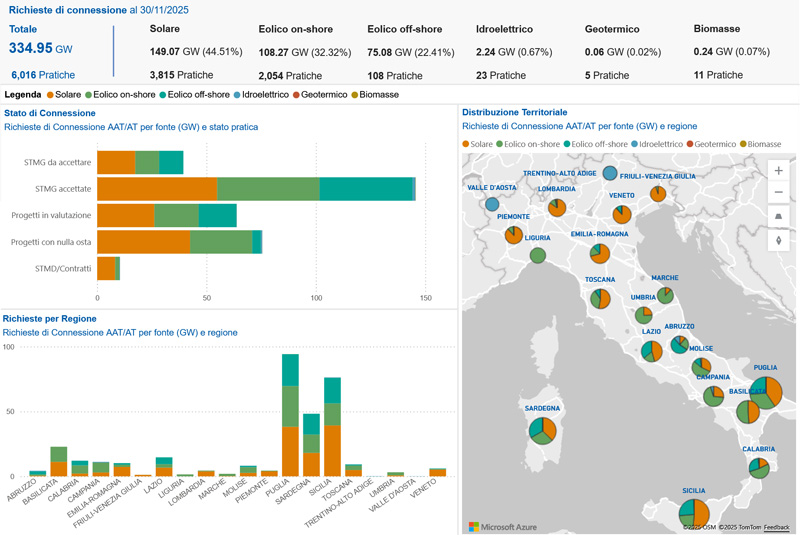
RES Connection Requests
At 31st October 2025, the renewable connection requests in Sardinia accounts for almost 48 GW (almost 700 active applications), 38% from photovoltaic, 30% from wind on-shore, 31% from wind off-shore. Almost 80% of these requests are in the 2nd of the macro phases with the STMG accepted by the applicants.
The trend of high-voltage connection requests (HV/EHV) for renewable energy projects in Sardinia, after a steady increase from 2018 to a peak in 2022 (about 11 GW), has sharply declined in the following years, reaching about 3.3 GW in 2025 (till October).
The information related to RES Connection Requests are available on the web:
Sardinian Electricity Grid: evolution
In Sardinia, as of Sicily and Campania, there is a strong production from non-programmable renewable sources – solar and wind in particular – which is constantly increasing. Construction of the Tyrrhenian Link is part of a larger picture, in which the two main islands require a reinforced interconnection to the mainland, also in the light of the expected evolution of the energy mix in Sicily and Sardinia (e.g. coal and most polluting plants will be phased out), and the increasing demand for connection of new renewable plants to the grid.
Therefore, this is a strategic infrastructure for the Italian electricity system, in view of the energy transition goals set by the National Integrated Energy and Climate Plan (PNIEC). Indeed, the Tyrrhenian Link will increase electricity exchange capacity and thus support the development and better use of renewable energy flows. Therefore, the project represents an enabling factor for the energy transition and decarbonisation of our energy system, considering that Italy will need to install around 65 GW of new renewable capacity (beyond that already installed at 31 December 2023) to meet the challenging national and European climate targets by 2030.
In detail, the new infrastructure will allow:
- greater electricity system stability, suitability and security in Sardinia, Sicily and Campania, a high degree of flexibility and integration of renewable production in Italy, and the possibility of meeting the national policy targets, as confirmed by the recent publication of the new PNIEC;
- an increase in the electricity exchange capacity between Campania, Sicily and Sardinia;
- the development of renewable sources;
- an increase in the competitiveness of producers in the electricity market.
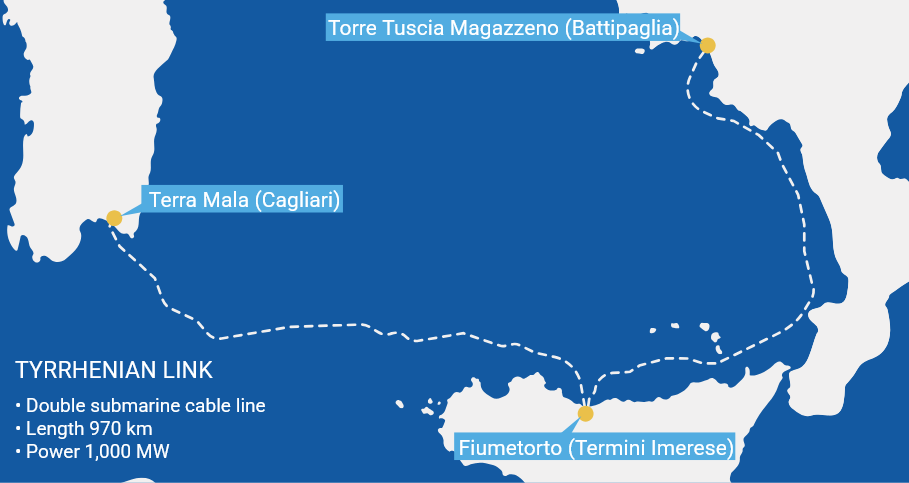
The new electricity corridor in the middle of the Mediterranean Sea.
More in detail, with a length of 970 km and a capacity of 1000 MW, the Tyrrhenian Link is a state-of-the-art project of international significance, and another step towards a more sustainable energy future. The overall project involves two sections: EAST from Sicily to Campania, and WEST from Sicily to Sardinia.
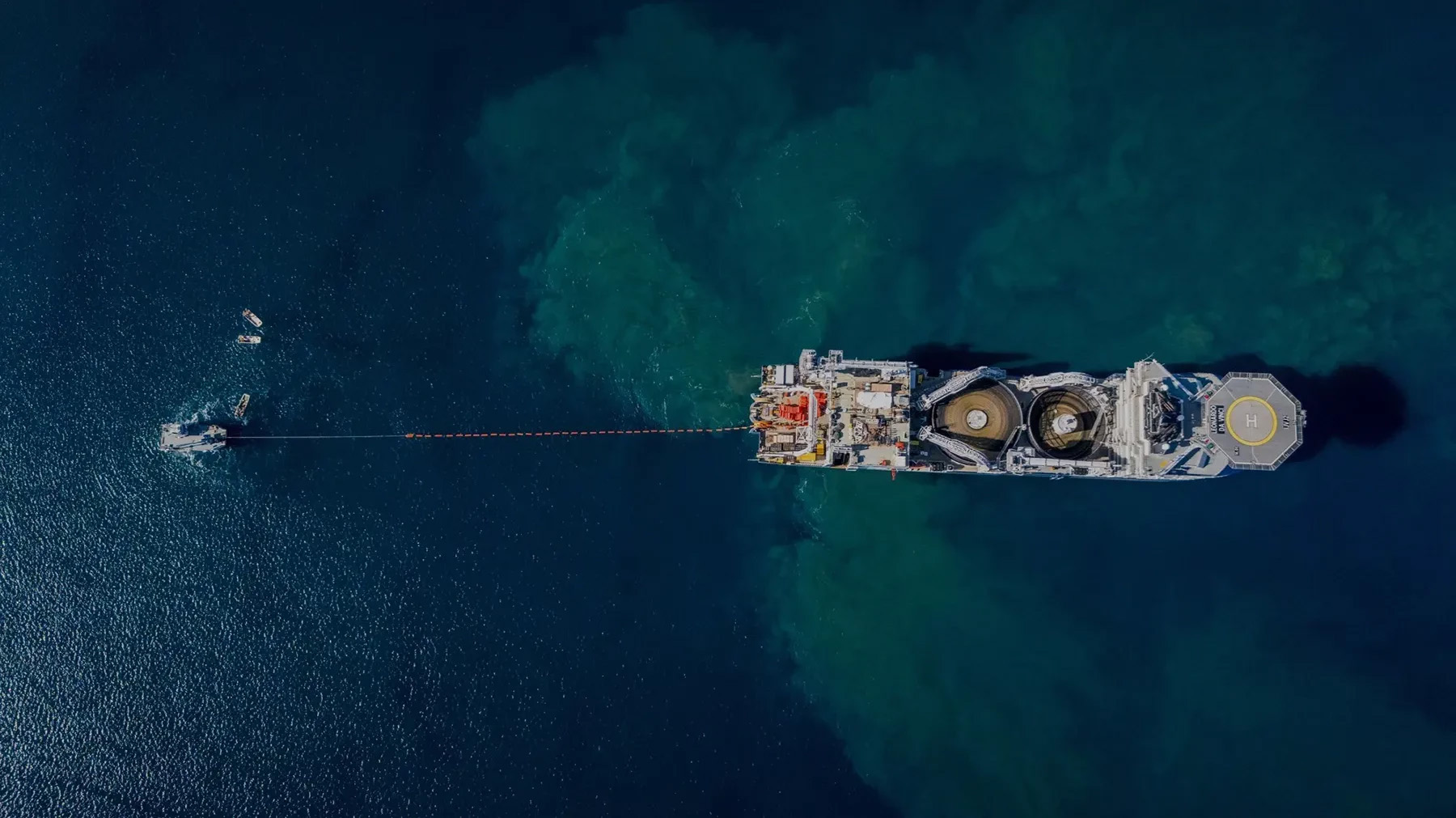
The Tyrrhenian Link is a major energy infrastructure project developed by Terna. It is designed to strengthen the national grid and support Italy’s energy transition by connecting Sicily, Sardinia, and the mainland (Campania) through a high-voltage direct current (HVDC) submarine cable system.
Another important infrastructure – after the 2035 – is the Sardinian Backbone, which will allow for the best possible integration of renewable energy plants planned in the coming years in the southern regions, facilitating energy flows from the South to the Central and Northern regions.
The backbone will include:
- the Fiumesanto – Montalto HVDC line (known as „Sapei 2“), using VSC technology and with a capacity of 1,000 MW, between the existing substations of Fiumesanto in Sardinia and Montalto in Lazio, where the converter station will exploit abandoned industrial sites. Thanks to the new VSC converter station, capable of providing significant support to grid voltage, the stability of the Sardinian grid will be significantly increased;
- the Sardinian Link, consisting of the reconstruction and subsequent capacity increase of the 220 kV network in the Sardinian hinterland by replacing the current pylons with innovative, low-impact supports called „5 Phases“ electromagnetic system.